Governor Grant
Black BeautyGovernor Grant is a long-serving London cabman whose standing among his fellow drivers gives him influence over disputes and practical decisions. In Black Beauty’s account, he is both a judge of horses and drivers and a man willing to help a family in difficulty. His conduct combines sound advice and generosity with a candidly admitted weakness for drink, a contradiction that keeps his kindness from becoming a portrait of effortless virtue.
Identity and Place at the Stand
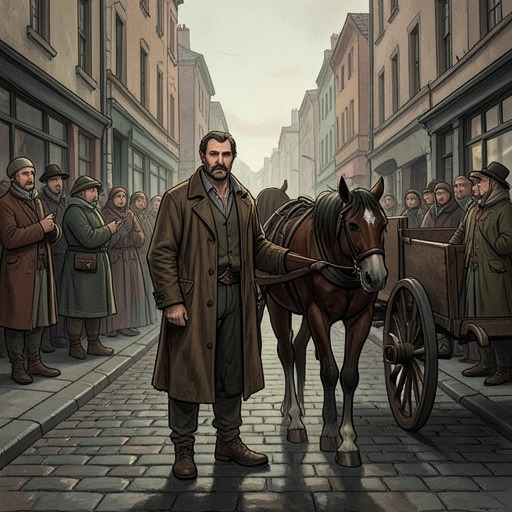
Governor Grant first appears as a broad-faced, gray-haired man in a gray coat and cape, with large white buttons, a gray hat, and a blue comforter. His imposing clothes are matched by an established place in the cabmen’s community: he has been at the stand longer than any of the others, and takes it upon himself to settle matters and stop disputes. The men make way for him, a small gesture that conveys the authority his experience has earned.
His judgment is practical rather than ceremonious. After looking Black Beauty over, Governor Grant tells Jerry Barker that the horse is the right sort for him and worth the price, regardless of what Jerry paid. The endorsement helps establish the horse’s reputation at the stand. Governor Grant is generally good-humored and sensible, but the narrator also records a less reassuring qualification: when his temper is out, sometimes after he has drunk too much, the others keep clear of his heavy fist. His position therefore rests on respect and forcefulness, not on an unblemished character.
Judgment of Drivers and Their Horses
Governor Grant’s views on driving emerge in his criticism of Larry. When Larry complains that a horse will not go without the whip, Governor Grant answers that Larry never takes the trouble to find out whether it will. He points to Larry’s constant use of the whip and his repeated changes of horses, connecting the driver’s impatience with the animals’ lack of peace and encouragement. The criticism is concrete: rough handling does not merely make a journey harder for a horse but, in Governor Grant’s account, wears the animal out and sends the driver looking for another.
This judgment complements his favorable assessment of Jerry. In speaking about wealth, Governor Grant tells Jerry that if he ever becomes rich, he will deserve it, and that his wealth will not carry a curse. He contrasts Jerry with Larry, whom he predicts will die poor because he spends too much on whipcord. The comparison is not simply about earning or spending: it rests on a difference in how the drivers treat their horses. Governor Grant recognizes Jerry’s restraint and care as qualities that matter, even while he knows that such conduct does not promise riches.
Friendship, Candor, and Drink
The exchange about drink complicates Governor Grant’s admiration of Jerry. After Jerry condemns the damage caused when drunk drivers injure sober people and their horses, Governor Grant admits that Jerry’s words have struck home. He says he is not as good a man as Jerry and wishes he were. When Jerry asks why he does not give up drinking, Governor Grant explains that he tried once, lasted two days, and felt as if he would die; he then asks Jerry how he managed.
The moment gives Governor Grant a capacity for self-knowledge without suggesting that he has overcome his dependence. Earlier, the narrator has linked drinking to his occasional loss of temper; here, Governor Grant himself names quitting as difficult and seeks to learn from Jerry. The exchange makes their regard reciprocal: he has publicly praised Jerry’s judgment, while Jerry speaks to him as a friend who might still change. The evidence records the attempt and the confession, not a later recovery, so his weakness remains unresolved.
Practical Help for Harry and Polly
Governor Grant’s concern for working horses becomes direct assistance when Harry Barker faces difficulty managing Hotspur. The family has to consider the horses’ feed while Harry’s father is away, and keeping the energetic young horse without work is proving difficult. Governor Grant proposes that, with Polly Barker’s agreement, he will take Hotspur out each day until another arrangement is made. He promises to bring Polly half of what the horse earns, recognizing that the family needs help with feed and that an idle horse will still consume resources.
The offer quickly becomes action. Governor Grant goes to see Polly; he and Harry harness Hotspur and take him out. He continues collecting the horse for a week or more, and when Harry thanks him, he laughs off the gratitude by saying that the arrangement is fortunate for him too: his own horses need the rest they would otherwise have missed. The explanation does not cancel the assistance. It shows Governor Grant making a useful exchange that supports the family while giving his own horses a respite, rather than presenting kindness as a grand or selfless performance.
Across these scenes, Governor Grant’s role is defined by intervention at an everyday scale: he evaluates a horse, checks a driver’s excuses, acknowledges a personal failing, and arranges work that helps a family and eases the burden on his own animals. His conduct gives the cabmen’s stand a form of informal leadership, grounded in practical knowledge and mutual dependence. At the same time, his own admission about drink and the narrator’s account of his temper prevent his advocacy from appearing morally simple: he can recognize humane treatment and act generously while remaining vulnerable to the very habits he criticizes in others.